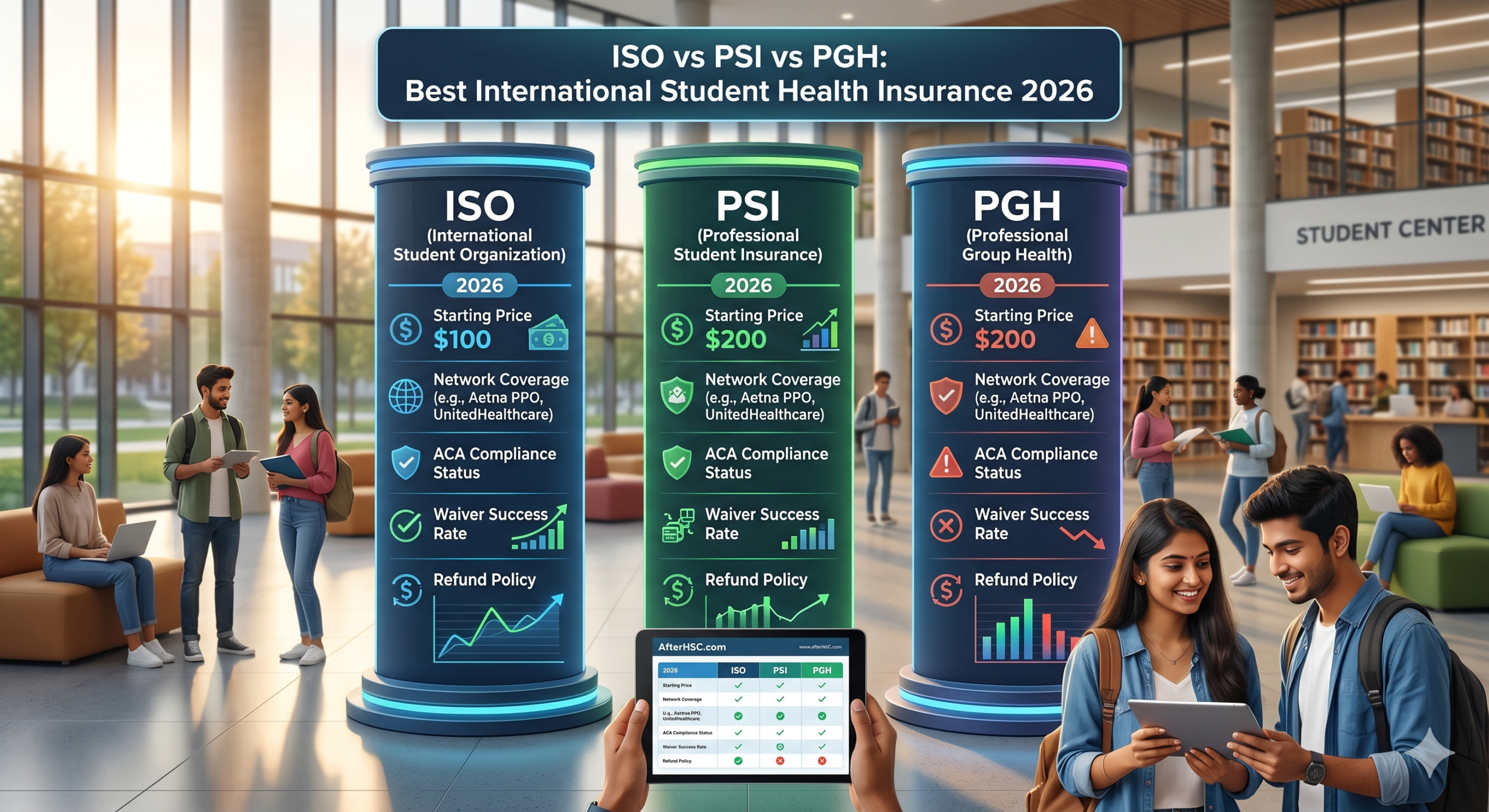
ISO vs PSI vs PGH: Best International Student Health Insurance 2026
For international students traveling to the USA or Canada in 2026, health insurance is not just a safety net—it is a legal and academic requirement. Most universities automatically enroll students in their Student Health Insurance Plan (SHIP), which can cost between $3,000 and $4,500 per academic year.
However, savvy students opt for a “Waiver.” By purchasing a private insurance plan from providers like ISO, PSI, or PGH, you can often get the same coverage for $500 to $1,000, saving you thousands of dollars for tuition or living expenses.
In this exhaustive 2026 guide, we compare ISO, PSI, and PGH to help you decide which plan will get your waiver approved and keep you protected.
Chapter 1: Why You Need a Health Insurance Waiver in 2026
In 2026, the cost of healthcare in the US has reached an all-time high. A single ER visit for a minor injury can cost over $2,000. Universities mandate insurance to ensure students don’t face financial ruin.
What is a Waiver?
A waiver is a formal request to your university to opt-out of their expensive insurance plan because you have purchased an independent plan that meets their specific requirements.
Chapter 2: ISO (International Student Organization) – The Reliable Giant
ISO has been the go-to for international students for decades. In 2026, they remain the top contender due to their massive network and high waiver approval rates.
Key Features for 2026:
-
Provider Network: ISO uses the Aetna PPO network. This is crucial because Aetna is accepted by almost every doctor and hospital in the United States.
-
Plans for Everyone: Whether you are on an F-1, J-1, or M-1 visa, or even if you are on OPT (Optional Practical Training), ISO has a specific plan for you.
-
2026 Refund Policy: ISO offers one of the best refund policies. If your university denies your waiver, you can apply for a full refund (check specific plan terms).
Popular ISO Plans in 2026:
-
ISO Care: The most balanced plan for major universities.
-
ISO Share: A budget-friendly option with slightly higher out-of-pocket costs.
-
ISO Shield: Designed to meet the strictest “Platinum” level requirements of Ivy League and top-tier state schools.
Chapter 3: PSI (Professional Student Insurance) – The Efficiency Expert
PSI has revolutionized the waiver process in 2026 by integrating directly with university portals.
Why Students Choose PSI in 2026:
-
Pre-Matched Plans: PSI’s website allows you to select your specific university. They then show you only the plans that are guaranteed to meet that school’s waiver criteria.
-
UnitedHealthcare (UHC) Network: PSI utilizes the UHC network, which is often considered the gold standard for student health insurance.
-
Affordability: On average, PSI plans are 40% to 60% cheaper than university-sponsored SHIP plans.
PSI 2026 Plan Levels:
-
Basic/Standard: Good for schools with low waiver requirements.
-
Enhanced: Meets the standard requirements for 90% of US colleges.
-
Presidential: The highest level of coverage with low deductibles and high maximum limits.
Chapter 4: PGH (Professional Group Health) – The 2026 Warning
While PGH was a popular low-cost choice in the past, the landscape has changed in 2026.
The ACA Compliance Issue:
Many universities now strictly require ACA-compliant insurance. The Affordable Care Act (ACA) sets high standards for what an insurance plan must cover (e.g., pre-existing conditions, mental health). ISO vs PSI vs PGH
-
The Risk: Many PGH plans in 2026 are “offshore” or non-ACA compliant.
-
Waiver Denials: We have seen an increase in waiver denials for students using PGH at schools like NYU, Georgia Tech, and UTD.
-
Recommendation: Only choose PGH if your university specifically lists them as an approved provider or if your school does not require ACA compliance.
Chapter 5: Head-to-Head Comparison (2026 Data)
| Feature | ISO Student Health | PSI Insurance | PGH Global |
| PPO Network | Aetna | UnitedHealthcare | Global Excel / Varies |
| Monthly Cost (Avg) | $35 – $95 | $60 – $110 | $30 – $70 |
| Waiver Success Rate | 98% | 99% (Matched) | 75% (Declining) |
| Maternity Coverage | Yes (Higher Plans) | Yes (Most Plans) | Often Limited |
| Mental Health | Extensive | Extensive | Basic |
| Customer Support | 24/7 Multilingual | 24/7 Digital Portal | Email/Phone |
Chapter 6: How to File a Successful Waiver in 2026
Follow these 5 steps to ensure you save your money:
-
Check the Deadline: Most waiver deadlines are 2 weeks before the semester starts.
-
Verify the Requirements: Look for keywords like “Unlimited Maximum,” “Maternity coverage,” and “Mental Health parity.”
-
Buy the Plan: Purchase your ISO or PSI plan and download the Summary of Benefits and Insurance Card.
-
Submit via Portal: Log into your university student portal (e.g., WGU Portal, MyUH, etc.) and upload the documents.
-
Confirmation: Wait for the “Waiver Approved” email. Once approved, the $2,000+ charge will be removed from your tuition bill.
Chapter 7: The ISO Advantage – Why Aetna PPO Matters in 2026
When you choose ISO, you aren’t just buying a policy; you are buying access to the Aetna PPO Network. In the healthcare world of 2026, network access is everything.
-
No Out-of-Network Surprises: Aetna is accepted by over 1.2 million healthcare professionals. This means you won’t get stuck with a $10,000 bill because a doctor wasn’t “in the system.”
-
Direct Billing: Most doctors in the Aetna network will bill ISO directly. You don’t have to pay cash upfront and wait for weeks for a refund.
-
Specialist Access: If you need a dermatologist, cardiologist, or physical therapist, ISO’s network makes it easy to find one near your campus without a long waiting list.
Chapter 8: PSI and the UnitedHealthcare (UHC) Synergy
PSI has strategically partnered with UnitedHealthcare, which is arguably the most recognized insurance brand in North America.
-
UHC StudentResources: PSI plans often leverage the same infrastructure that universities use for their own plans, making the “Waiver Approval” almost instantaneous in 2026.
-
Telehealth Integration: In 2026, PSI offers 24/7 “Virtual Doctor Visits.” If you have a fever at 2 AM, you can video call a doctor through the PSI app for a $0 copay.
-
Prescription Savings: PSI users get access to UHC’s pharmacy discounts, saving up to 80% on common medications at CVS, Walgreens, and Rite Aid.
Chapter 9: PGH Global – Assessing the 2026 “Risk vs. Reward”
While we previously issued a warning about PGH, it still has a place for specific students.
-
J-1 Scholars: If you are a visiting researcher or on a J-1 visa, the requirements are often less strict than F-1 degree-seeking students. PGH can be an incredibly cheap option that still meets the US Department of State’s basic requirements.
-
The “Group” Power: PGH often offers “Group Plans” for student organizations or cultural clubs. If you can get 20+ students to sign up together, the rates can drop significantly.
Chapter 10: Detailed 2026 Waiver Requirements by State
To make this the ultimate guide, let’s look at what specific states require in 2026: ISO vs PSI vs PGH
California (UC and CSU Schools)
California has some of the strictest laws. Your plan must include:
-
Unlimited Lifetime Maximum.
-
No waiting period for Pre-existing conditions.
-
Mental Health coverage equal to physical health coverage.
-
Recommended Plan: ISO Shield or PSI Presidential.
Texas (UT System and TAMU)
Texas schools often require a US-based claims office and a specific “Repatriation” amount ($25,000+).
-
Recommended Plan: PSI Enhanced or ISO Care.
New York (SUNY and Private Schools)
Most NY schools mandate that the insurance provider must be licensed to sell insurance in the state of New York.
-
Recommended Plan: ISO Gold or PSI Standard.
Chapter 11: Mental Health Coverage – A 2026 Priority
Mental health is no longer an “extra” in 2026; it is a core requirement. Both ISO and PSI have upgraded their 2026 plans to include:
-
Counseling Sessions: Up to 20-30 sessions per year with a $20 copay.
-
Inpatient Care: Full coverage for hospital stays related to mental health crises.
-
Addiction Recovery: Coverage for substance abuse treatments, which is now a standard requirement for many Ivy League waivers.
Chapter 12: Comparing Maternity and Newborn Care
For married students or those planning to start a family, this is the most expensive part of US healthcare.
-
ISO: Offers maternity coverage in their higher-tier plans, but there is often a 6 to 10-month waiting period. You must buy the plan before becoming pregnant.
-
PSI: Many PSI plans treat pregnancy as any other illness, meaning coverage starts immediately if the plan is ACA-compliant.
-
PGH: Generally offers the least amount of maternity support, often excluding it from their basic plans. ISO vs PSI vs PGH
Chapter 13: The “Fine Print” – Deductibles and Out-of-Pocket Maximums
Before you click “Buy,” you must understand these two terms:
-
Deductible: The amount you pay before the insurance kicks in. In 2026, most waivers require a deductible of $500 or less.
-
Out-of-Pocket Maximum: The “Safety Ceiling.” Once you spend this amount (usually $6,350 to $9,000), the insurance pays 100% of everything else.
Chapter 14: Summary Checklist for AfterHSC.com Readers
| Step | Action | Why? |
| 1 | Get the University Waiver Form | Know the rules before you spend. |
| 2 | Compare ISO and PSI | Use their “Search by School” tool. |
| 3 | Check ACA Status | Ensure it meets 2026 US federal laws. |
| 4 | Buy & Download PDF | You need the “Summary of Benefits” for the portal. |
| 5 | Submit Waiver | Do it at least 15 days before the tuition deadline. |
Chapter 15: Dental and Vision Coverage – The “Hidden” Expenses in 2026
One major mistake international students make in 2026 is assuming that “Health Insurance” covers everything. In the US and Canada, Dental and Vision are usually separate.
-
ISO’s Approach: Some ISO high-tier plans include basic emergency dental (for pain relief), but for routine cleanings or braces, you need a standalone “Dental Add-on.”
-
PSI’s Partnership: PSI often offers a discounted dental and vision bundle that can be purchased alongside your health plan for an extra $15–$25 per month.
-
The Cost of Neglect: Without insurance, a simple tooth filling in 2026 can cost $300, and an eye exam with glasses can exceed $500.
-
Pro-Tip: Check if your university’s student union offers a separate, cheaper dental/vision plan before buying a private one.
Chapter 16: Understanding the 2026 Claims Process (Step-by-Step)
Buying insurance is easy; getting them to pay the bill is where the challenge lies. Here is how the claims process works for ISO, PSI, and PGH in 2026:
-
The Visit: Always show your digital insurance card at the reception.
-
In-Network Billing: If you are in-network (Aetna for ISO, UHC for PSI), the clinic sends the bill directly to the insurance company.
-
The EOB (Explanation of Benefits): A few weeks later, you will receive an EOB. This is not a bill. It simply shows what the insurance covered and what (if anything) you owe.
-
Manual Claims: If you had to pay upfront (common with PGH or out-of-network providers), you must upload your itemized receipt and a “Claim Form” to the provider’s online portal within 90 days.
Chapter 17: Case Study 2026 – Saving a University of California (UC) Student $3,200
Let’s look at a real-world example: ISO vs PSI vs PGH
-
Student: “Harsh” (F-1 Visa at UCLA).
-
University Plan (UC SHIP): $4,100 per year.
-
Private Alternative (ISO Shield): $900 per year.
-
The Result: Harsh followed our guide, submitted his ISO documents 20 days before the deadline, and got his waiver approved. He saved $3,200, which he used to pay for 4 months of rent in Los Angeles.
Chapter 18: 2026 Policy Exclusions – What is NOT Covered?
Even the best plans from ISO or PSI have limits. In 2026, most plans exclude:
-
High-Risk Sports: Skydiving, paragliding, or professional racing (unless you buy a “Sports Rider” add-on).
-
Cosmetic Surgery: Elective procedures like Botox or cosmetic rhinoplasty.
-
Self-Inflicted Injuries: Injuries resulting from suicide attempts or high-risk illegal activities.
-
Alternative Medicine: Most plans do not cover Ayurveda, Homeopathy, or Acupuncture unless specifically stated.
Chapter 19: Staying Compliant with Your Student Visa (2026 Rules)
In 2026, the US Department of State and Immigration (USCIS) has increased scrutiny on student health coverage.
-
J-1 Visa Holders: You are legally required to have insurance that meets federal minimums ($100k per accident, $50k for medical evacuation). If you cancel your insurance mid-semester, your DS-2019 can be terminated.
-
F-1 Visa Holders: While the government doesn’t set a specific dollar amount, your university does. Falling out of insurance coverage can lead to a “Registration Hold,” preventing you from attending classes.
Chapter 20: The Future of Student Health – Trends for 2027 and Beyond
As we look toward 2027, we expect to see:
-
AI-Driven Diagnostics: Apps from ISO and PSI will likely offer AI symptom checkers to reduce unnecessary ER visits.
-
Wearable Integration: Potential discounts for students who share their “Step Count” or sleep data from Apple Watch/Fitbit to prove a healthy lifestyle.
-
Global Portability: Plans that cover you not just in the USA, but also while you are traveling home to India or vacationing in Europe during summer breaks.
Chapter 21: Frequently Asked Questions (FAQs) for 2026
Q1: Can I use ISO while on OPT?
Yes, the ISO OPTima plan is specifically designed for students on OPT and provides excellent coverage for a lower price than employer-sponsored plans.
Q2: Is the Aetna network better than UnitedHealthcare?
Both are excellent. Aetna (ISO) and UHC (PSI) are the two largest networks in the US. Choose the one that your local campus clinic or preferred doctor accepts.
Q3: My waiver was denied. What do I do?
Contact the insurance provider immediately. ISO and PSI both have “Waiver Support Teams” that will help you appeal the decision or upgrade your plan to meet the requirements.
Q4: Does these plans cover COVID-19 or new variants in 2026?
Yes, all ACA-compliant plans from ISO and PSI treat COVID-19 like any other respiratory illness, covering testing and treatment.
Chapter 22: Conclusion – The Final Verdict
-
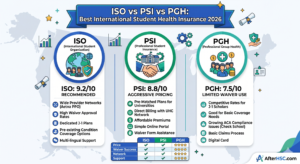
Choose ISO if you want the best balance of price and a massive network (Aetna). It is the safest bet for most students.
-
Choose PSI if you want a “No-Brainer” experience where the plan is already matched to your university’s portal.
-
Avoid PGH unless you have double-checked the ACA requirements of your specific school for the 2025-2026 year.
Final Tip for AfterHSC Readers: Always buy your insurance at least 10 days before the deadline. A small delay in paperwork can result in you being forced to pay the university’s $3,000 fee!